Tuesday, January 23, 2007

More Scenes from the Dakar Suburbs

Sweeping the street in the early morning, with the Atlantic Ocean in the background - this was on the main road running south from Dakar.


I took this photo of the old colonial building, and only later noticed the man with the missing hand. In all the countries where I've been in Africa I frequently see disabled people - many of whom have been maimed in war, crippled from polio, or who are born with deformities that in the West would be quickly put right soon after birth, but here people are too poor or there are no surgeons available.


Here's a street stall: note the Christmas tinsel!

Monday, January 22, 2007

Sunday, Sunday!
Today started out overcast and cool, and gradually the clouds got darker and darker and it eventually poured down for an hour or so. But by early afternoon it all cleared up and the sun popped out from behind the clouds, so I walked over to the office, marvelling at how quickly the sun was drying up all the puddles.

Some of my friends occasionally query how I spend my days at work. Sometimes I do too! Another week has gone by, and what did I achieve? With the start of the new year we are in the process of selecting partners to work with over the next couple of years. This has involved several visits to eleven different partner-NGOs (local non-government organisations working with children) gathering information about how they work and what they do that will help us select the best partners for our work. The visits are carried out by our local staff, although I sometimes do go out on field visits with them. Otherwise I'm in the office planning the overall work, reading their reports, making sure they keep on track with their work plans, and doing other desk work such as writing sections of our annual report, preparing monitoring and evaluation plans, thinking up ways to improve our work, record keeping and so on. It's amazing just how much time the planning takes - but good planning is enormously important, and saves time in the end.

For the next couple of weeks I'll also be busy managing the day-to-day activities of the office as a whole, since I'm acting head of mission while the real Head of Mission is away on leave. A couple of the logistical items to deal with are preparing the new house that I'll be moving into next weekend (we have a new international expat staff member arriving, and I'll be sharing the new house with him, leaving our Head of Mission some privacy in his own place); and making arrangements for the return of a former vehicle from Uganda. We use Toyata Land Cruisers - not the same as the fancy SUV's you see on the road in the US - specially adapted for field work in really rough places. When our office here was closed down temporarily in June 2004 following a military attack on the city, the cars were sent up to the Uganda program office. We are now retrieving one of them, and it will be driven from Uganda to the border with Rwanda, where two of our logistics team will meet it, and drive it back down here.

And now I'm heading back home, as some friends are coming over for Sunday afternoon "tea" and a chat. Will post more Senegal photos next week!


Fortunately it's still possible to get a really good cup of coffee in Dakar, in spite of all the advertising for Nescafe. But on the street guys are making a living selling shots of Nescafe in tiny plastic cups.

Thursday, January 18, 2007

More photos from Senegal
Here are a couple more photos - no time to post more today!


Sunday, January 14, 2007

Scenes from the Suburbs
The following photographs were taken while driving out of Dakar towards the Bandia National Park, or driving back from Lac Rose, about 35 km from the city centre.


This type of bus is known as a "car rapide" and is usually anything but, as it stops all the time to pick up more passengers!


Yummy french baguettes available everywhere!
Travels in Africa: my return trip from Dakar, Senegal to Bukavu, DR Congo

This is how it should have gone: arrive at Dakar airport at approximately 14:00h, in plenty of time to check in for 16:40h flight. Take Kenya Airways flight KQ 513 from Dakar to Nairobi, arriving Nairobi at 05:40h on Saturday morning. Leave Nairobi at 08:00h and arrive in Kigali, Rwanda at 08:25h (Rwanda is one hour behind Kenya), in plenty of time to take the 11:30h flight down to Cyangugu, where the office car would pick me up at 12:05h and take me across the border – allowing me a comfortable day and a half to recover from the trip and get my head together in time to arrive at the office refreshed at 08:00h on Monday morning.

No such luck! This is what actually happened:
Arrived at Dakar airport in 45 minutes, at 13:30, because there was less traffic than expected. Hadn’t had time to think about lunch. On checking-in found that flight was delayed until 21:30. Had already given away remaining CFA (west-African currency) so had no cash to buy food or even think about returning to town; Kenya Airways did not provide any refreshments for waiting passengers. Seats in the departure lounge were metal, and very uncomfortable. The flight finally commenced boarding at around 22:30 and we were airborne by 23:30. Seats were unassigned (after all the effort I had made to ensure I got an aisle seat close to the front!). We were served an indifferent meal at midnight. Wanted to sleep, but after 45 minutes the plane landed in Bamako (Mali), where it stayed for another 45 minutes, lights full on, systems revving noisily – impossible to sleep. At 09:00 Senegal time, midday in Kenya, we landed in Nairobi, without the benefit of breakfast, which had been cancelled for some obscure reason related to the previous delays. I had missed my connection to Kigali, and also the further connection to Cyangugu.

At Nairobi airport there’s a woefully under-staffed service desk where people go to check in for their next flight if they’re in transit, or to sort out messes like mine (and almost everyone else on my flight). I spent over three hours at the service desk, waiting for someone to figure out which flight they would put me on to get to Kigali, and what to do about the fact that the Sunday flight to Cyangugu had been cancelled and there wouldn’t be another one until Tuesday. Having enjoyed one small meal in the previous 24 hours, and a mere three or four hours sleep (no Maggie Thatcher, me!), I was expecting to keel over at any minute. Some intelligent person decided they’d best put me up in a hotel overnight and send me on my way to Kigali the following day. Once that was decided, I then had to go through immigration (Kenya Airways paid the $20 transit visa fee and I breezed through), and make my way downstairs to the airline’s hotel accommodation desk and wait in line again. When the young woman asked for my boarding pass for the following day’s flight (required before a hotel room voucher could be issued), which I didn’t have, and then told me I needed to go back upstairs, through immigration to the departure concourse, to the service desk to get one, I knew that I’d reached my limit of physical and mental endurance. “I haven’t eaten anything for over twelve hours, I’ve had only three hours sleep, and I think I’m going to faint” I told the woman in desperation. Fortunately she was sympathetic and there wasn’t a crowd waiting for assistance, so she told me to sit down, conjured up a box of hot, juicy chicken, grabbed my ticket, and went off to do battle at the service desk far more efficiently than I could have done. About half an hour later, boarding pass and hotel voucher in hand, I went out to board the hotel bus. I was more tired than ever, and when I discovered an empty bus that was not going to move until it was full (about two hours away), I burst into tears from sheer exhaustion. Once again I was rescued by a sympathetic person - this time the bus driver, who went off to make whatever arrangements he needed to make, and then returned to drive me, the sole passenger on the bus, to the hotel on the highway halfway between the city and the airport. On the way the driver did his best to cheer me up by pointing out the giraffe family in the park outside the airport, and I cheered up thinking how wonderful it was to see giraffes and to be in Kenya, where everything was looking unusually green after all the rain, and knowing I’d soon be in the luxurious Panari hotel and could order a pot of good Kenyan tea, which I knew would automatically be served with milk, unlike in Senegal where milk is an unusual request.

Soon after 16:00 (four hours after landing!) I was settled into an eighth floor room with extensive views towards Nairobi city center in one direction, and flat parkland in the other, running a hot bath, enjoying the tea, and grateful that I’d put a change of underwear and clean shirt in my carry-on back-pack, as my suitcase was still at the airport. At 07:00 the next morning a mini-bus picked up me, and a small group of other passengers, to take us back to the airport. The place was jam-packed with people of all colors and nationalities waiting in lines all over the place. Fortunately I didn’t need to check in again, so stood in the immigration line, which moved with unexpected efficiency. The same efficiency was not in evidence back at the service desk, where I’d been told to go and collect my $100 compensation from Kenya Airways to help me get from Kigali to Cyangugu (not enough to cover the actual cost, as it turned out), and where the long line promised another three-hour wait and the certainty of another missed flight. So I went right to the front of the line and asked, as loudly as I could, for the duty manager, and asked him for the money I was owed for my delayed and cancelled flights. For anyone who knows me, you’ll know that I never jump queues, but at that point if I’d stood in line again I really would have missed my flight to Kigali, and not having any cash on me I really had no other option. After another half-hour or so of waiting, someone from the finance office finally showed up to give me a crisp $100 bill and a waiver form to sign – no getting any further compensation out of them! After a quick stop at the duty free shop (where they take credit cards) to pick up chocolates, Kenyan macadamia nuts, and the latest Alice Walker and Scot Turow novels, I headed for gate 4 from where the Kigali flight always leaves. Expecting to come across at least one person I knew, I was not disappointed. As I walked slowly through the departure lounge looking around at the mix of faces, someone called out my name – my boss’s partner. And I was lucky, because she knew it would cost me more than $100 to go by taxi down to Cyangugu, and she gave me another crisp $100 bill before we landed in Kigali.

As soon as I was through immigration I switched on my mobile and called Ezra, the most reliable Kigali taxi driver I know. My luck was in, and he was available for the long drive. He was there at the curbside within 10 minutes and we headed into town, first to change those crisp bills into Rwandan francs, and then to fill up on gas. It was close to a year since I’d made that drive from Kigali down to Butare and I enjoyed it as always. Rwanda’s rolling hills were greener than ever after a strong rainy season – unlike the same time last year – and the familiar countryside was restful on the eyes. After a couple of hours we arrived in Butare, my old “ home town”, and stopped at the Ibis Hotel for lunch and to hand over gifts sent from Rwandans in Senegal to a friend in Butare. Christopher, who works with IRC in Bukavu, found me there at the Ibis. He’d also come down from Kigali by taxi, and was waiting for the IRC car to meet him in Butare and then take him the next 3-hour segment of the drive. He invited me to join him, so I told the happy Ezra he could head off back to Kigali. And then Christopher and I waited, and waited. Turned out the IRC car had left Bukavu a couple of hours later than it should have, and also had a flat tire on the way. It finally showed up at 16:00 – by which time we knew there was no way we would reach Cyangugu in time to make it across the border which closes every day at 17:00. That would be my third night on the journey since leaving Dakar. We made a brief stop in Gikongoro to get the tire fixed, enough time for me to call my Dutch friend Doutsen who came to chat for ten minutes before we set off for the drive through Nyungwe forest. Towards the end of the drive the mist moved in, it grew dark, and the way to Cyangugu seemed longer than ever. Eventually we got there, and drove up to the entrance of the Peace Guest House (run by the Anglican church in Rwanda). Dinner, an omelet for me, fish brochette for Christopher, took the usual hour or so to arrive, and I was instantly missing the excellent fast “fast” food available all over Dakar. My bed for the night felt cold and damp compared to the comfortably cool, dry nights in Dakar. We skipped breakfast in the morning, had no trouble crossing the border – no bribes requested, nobody checked our health documents, nobody asked to look through our luggage – and I arrived at my office by 09:20 Monday morning, just about two days later and much more tired than planned!

Saturday, January 13, 2007

Baobab Trees in Senegal

One thing I loved in Senegal are the baobab trees. This one is at the entrance to Bandia National Park, near Dakar.


This baobab is estimated to be around 800 years old, and was used as a cemetary: the bodies of "griots" were "buried" in crevices within the tree.


Here's a young visitor looking at the old bones inside the baobab.


The baobab fruit produce a delicious juice.


Giraffe and a baobab: for some reason I thought that giraffes were only found in eastern and southern Africa. I was wrong! This is in Bandia National Park, near Dakar.

Thursday, January 11, 2007

Back in Bukavu

Yes, I'm back in Bukavu (DR Congo). Have lots to write about regarding my vacation in Senegal, but last night got distracted by the new TV in our house, with around 50 digital stations including 3 BBC stations!! Of course, most of them are pretty bad, and I expect the novelty of TV will soon wear off.

With regards to more serious topics, today I read the following item which was on Relief Web, and comes from the international NGO Medecins Sans Frontiers (MSF - aka Doctors Without Borders):

MSF issues 'Top Ten' most underreported humanitarian stories of 2006

The ten countries and contexts highlighted by MSF accounted for just 7.2 minutes of the 14,512 minutes on the three major U.S. television networks' nightly newscasts for 2006

MSF and MSF Podcasts: New York - The staggering human toll taken by tuberculosis (TB) and malnutrition as well as the devastation caused by wars in the Central African Republic (CAR), Sri Lanka and the Democratic Republic of Congo (DRC), are among the "Top Ten" Most Underreported Humanitarian Stories of 2006, according to the year-end list released today by the international humanitarian medical aid organization Médecins Sans Frontières (MSF).

The ninth annual list also highlights the lack of media attention paid to the plight of people affected by the consequences of conflict in Haiti, Somalia, Colombia, Chechnya and central India.

"Many conflicts worldwide are profoundly affecting millions of people, yet they are almost completely invisible," said MSF (USA) Executive Director Nicolas de Torrente. "Haiti, for example, is just 50 miles from the United States and the plight of the population enduring relentless violence in its volatile capital Port-au-Prince received only half a minute of network coverage in an entire year."

According to Andrew Tyndall, publisher of the online media-tracking journal The Tyndall Report, the ten countries and contexts highlighted by MSF accounted for just 7.2 minutes of the 14,512 minutes on the three major U.S. television networks' nightly newscasts for 2006. Treating malnutrition, TB, and Chechnya were mentioned, but only briefly in other stories. Five of the countries highlighted by MSF were never mentioned at all.

The 2006 "Top 10" list also focused on the devastation caused by TB and malnutrition.

The frightening situation of worldwide TB became even worse in 2006 with the detection of extensively drug resistant tuberculosis (XDR TB), a strain that is resistant to both first-line antibiotics and to two classes of second-line drugs. At the same time, none of the TB drugs currently in development, however promising, will be able to drastically improve TB treatment in the near future.

"TB destroys millions of lives around the world every year, but we're not seeing the necessary urgency to tackle the disease," said Dr. Tido von Schoen-Angerer, director of MSF's Campaign for Access to Essential Medicines.

Hope is on the horizon, though, for malnutrition, with new strategies based on outpatient treatment that relies on ready-to-use therapeutic foods (RUTF), like Plumpy'nut, showing tremendous promise. Unfortunately, these strategies are not implemented as widely as they could be.

"Acute malnutrition contributes to the deaths of millions of children every year," said de Torrente. "New strategies in treatment of moderate and severe acute malnutrition have helped MSF treat more than 150,000 children in Niger over the past two years. Millions more children throughout the world could benefit if such strategies were more widely implemented."

While the conflicts in the Darfur region of Sudan and in eastern Chad garnered significant media attention in 2006, the steady focus did not translate into improved conditions for people caught up in the conflict.

"Even though there was more reporting about Darfur than about other crises, the situation continued to deteriorate to the point where MSF and other aid groups had to scale back their programs," said de Torrente. "We know that media coverage does not generate improvements on its own. However, it is often a precondition for increased assistance and political attention. There is perhaps nothing worse than being completely neglected and forgotten."

You can find details of these 10 under-reported stories (including one on the war in DR Congo) at the MSF web site: http://www.msf.org/

Thursday, December 28, 2006

I realize that my photos are scarcely representative of life in Dakar. That's because it's just not a great idea to take my camera out onto the street as long as I'm walking around on my own. I'm planning on taking a day-trip outside of town on Friday with a group, and hope to take photos then.

Today I discovered the French Cultural Center - definitely a great place to hang out for a few hours, a quiet garden oasis in the middle of the chaotic city. It has a large garden-courtyard area, a lovely dark pink two-storey building with wrought-iron balcony and shuttered windows, various artistic pursuits going on, a small open-air amphitheatre, and a relaxed restaurant/cafe with great food. I sat there for several hours enjoying a seafood salad, tea, ice cream cake, and a Robert Goddard mystery novel.

Man's robe: detail

Dakar sky line at dusk, with minaret.

Dakar: birds at dusk. In the foreground is the top of the Hotel de Ville (town hall); just beyond, a ship in the port of Dakar.

Saturday, December 23, 2006

Violence Against Girls in Africa

I just came across this information last night on an e-mail list I subscribe to. I've read quite a lot about violence against women in Africa, but some of these statistics were still able to shock me. The web site, for those interested, is:
http://www.comminit.com/africa/strategicthinking/st2006/thinking-1900.html

Born to High Risk: Violence Against Girls in Africa
David Mugawe, Antoinette Powell
African Child Policy Forum
2006
Executive Summary
Each year as many as 40 million children under 15 years old experience some form of violence. Many of them are girls and many live in Africa. For example, a study by The African Child Policy Forum in Ethiopia found that every girl interview had experienced some form of violence at one time or another and that more than 90 per cent of girls questioned in Uganda had experienced some form of sexual abuse. Girls throughout Africa experience physical, psychological and sexual violence in many forms and in various settings: in conflict and crisis situations; where they work or are trafficked to work; and even in the very places they should feel safest - at school, and in their homes and communities.

Although the international community now acknowledges the severity of the problem of violence against children and, to some extent the urgency with which it must be addressed, the particular vulnerability of girls to violence, and the social context that places African girls at risk, remains largely ignored.

The African Child Policy Forum believes that the issue can no longer remain hidden; that action should - and indeed must - be taken to address the abuses African girls face. This report, along with the Second International Policy Conference on the African Child on May 11 and 12, 2006, aims to enrich work on violence against children in Africa and to provide a framework for action.

Born to High Risk: Violence Against Girls in Africa synthesises information from three sources:
Existing literature on gender-based violence and violence against children.
Five thematic studies on violence against girls in specific settings that The African Child Policy Forum carried out in collaboration with the Inter-African Committee on Traditional Practices Affecting the Health of Women and Children; the International Committee of the Red Cross; the International Labour Organization; the Uganda Child Rights NGO Network; and UNAIDS.
Retrospective surveys of the of girls' experiences of violence in Ethiopia, Kenya and Uganda.
It provides strong foundations for future action by exploring the concept of violence and identifying what makes African girls especially vulnerable to various forms of violence.

The purpose of this report is not to judge who has failed in their duty to protect girls. It is a call for action from the girls themselves, whose voices - usually so seldom heard - reverberate throughout the study.

Girls in crisis situations such as conflicts and after natural disasters are targets of violence. For example, it is estimated that between 250,000 and 500,000 Rwandan women and girls were raped during the country's 1994 genocide. Across Africa - from Uganda to Liberia to Angola - girls as young as 12 have been abducted during conflicts and forced to fight, work as servants or become sexual slaves for combatants. Girls in refugee camps face similarly challenging conditions with high levels of violence. Teenagers from a refugee camp in Liberia explain that the people who should be working to protect them abuse their trust by forcing them to exchange sex for food.

But it would be a mistake to assume that girls face abuse only in such exceptional circumstances. Violence is widespread in the homes and communities of African girls:
31 per cent of girls questioned in a survey in Uganda had experienced sexual abuse.
A survey in Ethiopia found that one quarter of rape cases were perpetrated by a male relative.
In some regions of Nigeria, girls marry on average just after their 11th birthday.
Around 130 million women and girls have undergone female genital mutilation, most of whom live in Africa.
Schoolgirls face violence in their classrooms and on their way to school; according to The African Child Policy Forum's retrospective survey, female teachers (16 per cent) were the main perpetrators of physical maltreatment on girls in Kenya; around 50 per cent of Malawian schoolgirls report that they have been sexually touched against their will. Although male peers are responsible for much of the sexual abuse that takes place in school, teachers carry out an alarmingly high proportion of the abuses: a national survey in South Africa found that 32 per cent of reported child rapes were carried out by teachers. Further:
A survey in Ethiopia by The African Child Policy Forum found that 72 per cent of children had been slapped when at school.
67 per cent of schoolgirls surveyed in Botswana had been sexually harassed by their teachers.
A 2005 survey in Cameroon found that 16 per cent of secondary students had been sexually abused.
Cutting across girls' experiences of violence is the lack of support they receive from their families and communities. The harm that is inflicted by the violent act is compounded by the lack of a forum for women and girls to share experiences and views - with each other, and with men and boys.

The impact of violence against girls is immense for both individual girls and for society. Girls experience health and behavioural problems and may go on to perpetuate a cycle of abuse. We should end violence against girls for their sake and to protect their most basic human rights, but also because the cost to society will be vast if we do not. The services needed when girls experience violence - including healthcare, and police and social services - are expensive and probably far more so than preventative measures.

Violence infringes fundamental human rights. It is unacceptable. We must speak out against violence against children; we should confront attitudes that tolerate it; we can no longer conceal its existence. It is inexcusable that one in every two girls in Mali and Ethiopia will marry before their 18th birthday; that thousands of girls are abducted to serve as soldiers, domestic servants and sexual slaves in Uganda; schoolgirls in The Democratic Republic of Congo are forced to trade sex for grades; and 6,000 girls will be genitally mutilated today. These are our children. They are our responsibility.

And so we call upon governments and civil society to act decisively and promptly. Every one of us must commit time and resources to ending the gross injustices that will continue to take place in every country across Africa until we raise our voices to end them. On this basis, we suggest the following actions as a way forward in addressing violence against girls in Africa:
Girls must be legally protected from violence. Governments should draw up national policies to protect girls and give them free and fair access to legal redress.
Education is fundamental to creating a non-violent society. Families, communities, national and international policy-makers, and those responsible for implementing policy at country-level can play an essential role in initiatives to raise awareness of the devastating impact of gender-based violence. Support groups enabling girls, women and men to speak out about violence in their communities and abuse they have themselves experienced can help to break the cycle of violence.
Lessons must be drawn from the successes of practical programmes that provide assistance to girls who have experienced violence. These can provide valuable insights for implementing similar support mechanisms across Africa.
Where member nations of the African Union have not yet ratified or implemented the African Charter on the Rights and Welfare of the Child or the United Nations Convention on the Elimination of All Forms of Discrimination against Women they should do so as a matter of urgency.
Comprehensive information is needed if governments and civil society organisations are to implement informed, effective programmes to address gender-based violence. Governments and civil society organisations must actively engage in collecting statistical data on gender-based violence and reviewing its structural causes.
Policies and strategies will remain ineffective if resources are not allocated to implement initiatives to combat violence against girls. Governments and the international community must demonstrate their commitment to ending violence against children by mobilising resources to meet programmatic and policy needs.
Increasingly, children are perpetrating violence against children. And so it is vital to involve children as part of any solution to address violence against girls.


Click here to read the full document.


Contact:
The African Child Policy Forum
P.O. Box 1179
Addis Ababa
Ethiopia
Tel: +251-11-5528407/09/10
Fax: +251-11-5513420
info@africanchildforum.org
African Child Policy Forum Website

Source: Youth InfoNet August 27 2006
Things I like about Dakar:

The weather at this time of year is perfect: warm and cloudless during the day, cooling down pleasantly in the evenings; great food: I’m addicted to the Lebanese charwarma – thin pitta bread filled with lamb, tomatoes, onion, flat parsley, tahini, spicy mustard, and a few small fried potatoes, all of which I wash down with fresh-squeezed orange juice; French bakeries with crusty brown bread and yummy pastries; the men and women walking the streets with fabulously flowing damask robes in spotless glowing whites, purples, emeralds, pinks, atop stiletto heels or pointy flat slippers on the men; even though the streets are full of noise, traffic, bustle, and hustlers everywhere, a quiet spot from which to gaze at the surprisingly calm Atlantic is never more than a ten minutes’ walk in any of three directions; two really good book shops; all the different types of people to be found here: Africans from different countries; north Africans; Mediterraneans (mostly of Lebanese descent); Europeans – which allows me to walk around without hassle as long as I make an effort not to look like a tourist; friendly people – especially the Lebanese business owners and the ticket clerk at the museum; the sound of the call to prayer from the mosques (and the fact that it’s not too loud so I can sleep through the early morning call); and back again to food – fast food places where the food is both fast and very tasty, and plenty of places where I can get good prepared food to take back to my room thus avoiding eating alone in expensive restaurants. I expect I’ve forgotten a few things, but you can add some more if you’ve ever been here!

Friday, December 22, 2006

Reporting from Dakar, Senegal

I'm here in disguise. After a pleasant session at a salon de coiffure owned by a local Lebanese brother and sister couple, my hair is a shade darker than the original version, and I now pass for a local as I walk around the streets of Dakar. This is a great help, as I don't get hassled by the hundreds - if not thousands - of young men on the streets selling everything from sunglasses to synthetic miniature Christmas trees.

I didn't think that anywhere in Africa could be poorer than eastern Congo, and maybe Senegal isn't actually any poorer; but the street children I've seen here are younger than anywhere else I've ever seen, and the number of people who appear to be living on the street is not only far higher but of a far greater age range than anywhere else I've been. It's possible that all the people I see sitting on the street aren't actually living on the street...but I don't see any other immediate explanation for their presence.

On the other hand, Dakar has a great deal going for it, if you have some money to enjoy what is on offer. There are real shops, selling quality goods, a large supermarket with shelves of delicious, and pricey, imported French cheeses and a myriad of other delicacies; a superb French bakery full of dark chocolate gateaux and almond croissants and crusty baguettes; two excellent bookshops; hotels by the ocean...

Thursday, December 07, 2006
On any given day there are about 8 children in the Bukavu central prison, all boys. A news video on the MONUC (UN mission in DR Congo) web site shows an activity that we held there to dramatize the rights of children. Go to www.monuc.org then click on Videos, and then on ONU Raportages 9 to watch the video. It's 19 minutes long, and our segment is preceded by segments on the Congo elections and on HIV/AIDS awareness raising. It's only worth taking a look if you have high speed internet access.

This event was held on 20th November, International Day for Children's Rights. On the same day we also held an introductory workshop on children's rights for 50 marginalised teenagers from across town. It was quite a demanding session, getting the kids - many of whom have very little education - to sit down in groups and work on questions and issues relating to their rights. However they enjoyed the opportunity, and it was great to do direct work with them - generally our work involves training the teachers and care-givers who work with the children.

Saturday, December 02, 2006

Am I here?

There are two levels of problems with the internet connection here. One is at the office level - this is about to improve, at last! The second problem is the satellite connection. Since there are no landline telephones, and no cables (neighboring Rwanda has just installed broadband cable along all the main roads - I'm very jealous!), we must rely on satellite. And when it rains, that link goes down. We are now in the rainy season and it rains day and night! The connection comes and goes, so even as I write, I'm not sure when this will get posted.

Water woes.

I thought I'd write a word or two about water. In Africa, it seems, there's either too much of it or too little. And here in Bukavu we manage to have both problems at the same time. It is raining, and this week mudslides in town brought down a few houses and killed several children. Mud is every where. I pick my way carefully through the puddles and squelch along the slippery tracks that serve as roads, even in the best part of town. Four-wheel drive vehicles with heavy duty tyres slip and slide up and down the hillside neighbourhoods. Mud here is especially viscous. As is the water in my shower. A few weeks back I noticed that my hands felt sticky after washing; I've never come across sticky water before. Apparently it's the lake water. Generally our water comes from the river Rusizi that feeds into Lake Kivu, but sometimes they switch the supply over to the lake. I haven't figured out yet why we have water problems when there's so much rain. In the office we often don't have any water at all, or only on the ground floor as the pressure isn't sufficient for it to come up to the first floor where our offices are. At home there's frequently not enough pressure to supply water in the mornings, but it will come back in the evenings. A few days ago all the water was cut off for about three days, without notice - so we didn't have any stored. Fortunately the climate is relatively cool, so three days without a shower was manageable. I did enjoy a good hot shower when the water came back on!

Saturday, October 14, 2006
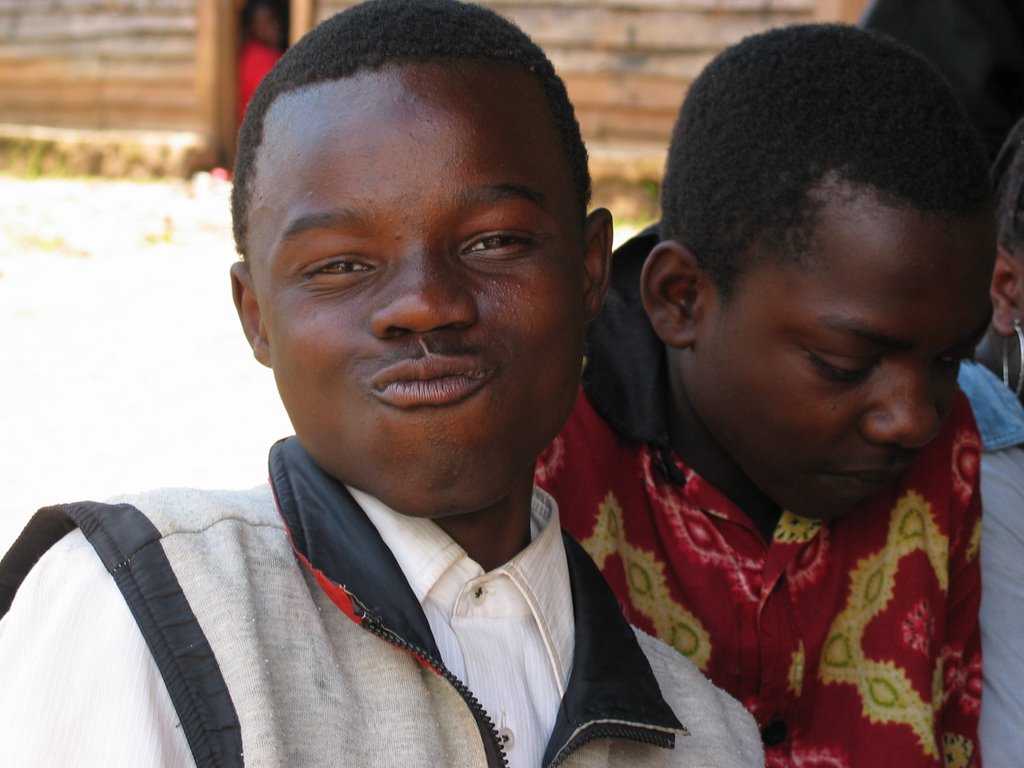
Really, really bad internet connection!

Our internet connection is getting worse and worse. At the moment I cannot send any messages with attachments, and just sending a regular message can take up to 15 minutes if it goes at all. Will not even attempt to post any more photos until this problem has cleared up! We are also moving office in the coming week, which means that we'll be without any internet at all for a few days.

Election campaigns are on again here - the second round presidential election will be held on October 29th, along with (I think) legislative elections. Or maybe it's provincial representatives....

Sunday, October 08, 2006
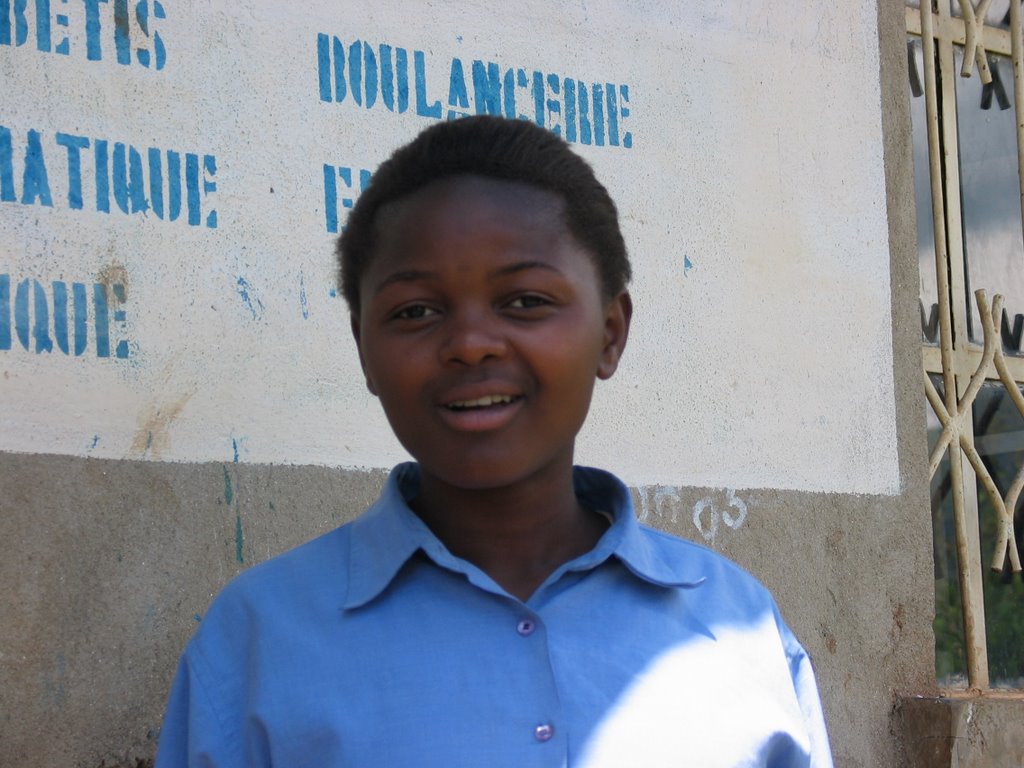
Gorilla Photos!

Internet access is still poor, but I'm going to see if I can get at least one or two photos up today. The park where I went to see the gorillas is called Kahuzi-Biega, and if you Google it, you'll find out more information.


Male Silverback Gorilla; photo by Carol Dehasse

Tuesday, October 03, 2006

A Spot of Malaria

Little Miss "I never get malaria" finally came down with malaria... though it really wasn't bad, and after 3 days off work I'm back at my desk again. However internet access has still not improved.

For those of you with broadband access, go to www.warchild.nl and then below the peace signs click on the phrase: "Bekijk hier de live-uitzending von 21 september" and then you'll see a 45 minute video of our International Day of Peace event here in Congo. Enjoy!! (Hurry - I'm not sure that it'll be up on the site for much longer!)

Saturday, September 23, 2006

21 September International Day of Peace


Photo: Wim Mulder

Chinese, Pakistani, and Uraguayan blue berets mixed with Congolese children to create the international peace symbol here the day before yesterday. First the symbol was created by the children alone (see above photo), and then the blue berets joined in later. The live images were sent via satellite to Holland where they were broadcast on a giant screen at the beach near The Hague where Dutch children were also making a peace sign. The event was also seen live on the internet at www.warchild.nl and clips were also shown on the Dutch TV news during the day. At the time of writing some photos from here can be seen on the web site, and I'm hoping that the film clip will soon be added, for those of you who have highspeed access! The site changes daily.

The event here was the result of several weeks of planning by our dynamic Head of Mission (Ramin Shahzamani) and plenty of hard work on the part of our local team. In addition to the peace symbol the children also performed sketches, poems, music, dances, and sang a special 'peace song'. Most applause, however, went to an impromptu kung fu demonstration by the Chinese engineer unit!

When I get more internet access I have a lot more photos to be posted. Check this site often!

Sunday, September 17, 2006

Elle est courageuse!

I’ve come into the office on Sunday morning to use the internet. We actually have electricity, but our ISP guys are obviously still in bed and haven’t bothered to turn on their equipment yet. Since there are no functioning banks here, the guys who provide the internet connection (by satellite, I presume, as there are no telephone landlines) also provide banking services. And since they’re Indian, they also supply the Indian Air Force (who are in charge of the small MONUC airbase an hour’s drive out of town) with spices. We were at the IAF base last week in order to interview the MONUC commander, who happens to be Dutch (we’re a Dutch NGO), as he was passing through. The Indians have developed a small haven of beauty and order amidst the general chaos; their camp is immaculate, with flowers everywhere, neatly bordered footpaths between the tents, a large well-tended vegetable garden, a fountain providing a gentle shower that sparkles in the sunlight as it waters the tiny lawn outside the tent that serves as their officers’ club. Even a separate, sign posted, and spotless toilet with imported toilet paper for women visitors to the camp – what a miracle! (I have photographs of what is meant to pass for toilets at a local school that I shall post to the site whenever I get around to it).

Hmmm, I meant to write about something completely different – how did I get on to toilets?!! As I was saying… the internet is down, so I’m writing this on the computer with the hope that I can post it onto the blog today, because my own computer still doesn’t have any internet access at all, so once the week begins it’s difficult for me to get access.

On my last post I mentioned the discussion sessions that we’re holding with teachers, to encourage them to find their own solutions to problems with the children. Many of the problems are fairly ordinary – the kind of problems with children’s behavior that teachers everywhere come across. When they began talking about problems with aggressive youngsters who are bullying others I wanted to tell them (but didn’t) about some of the schools in the US where metal detectors have been installed to catch the kids with guns and knives. Sometimes a ‘problem’ isn’t a problem, like the teacher who asked how to stop a pupil writing with his left hand. I was surprised (to say the least) that some teachers here still believe that left-handedness is something bad that can be corrected and they try to force the child to change. Some problems are caused by the general circumstances that make me want to give up in frustration at the seeming impossibility of changing things: many children go to school on an empty stomach, without even having had a glass of water or anything to eat the night before, so they fall asleep in class. Teachers want to know how to deal with the sleepy children. How can a child who hasn’t eaten stay awake or even concentrate in school? Many people are so poor that they may not even eat once a day. Another young adolescent boy often begins crying during class. Apparently he had witnessed the rape of his mother. Sexual violence against women and even very young girls here is epidemic and has contributed to the general breakdown of society, as many husbands and families will reject a wife or daughter who has been raped, such is the stigma attached to it.

All kinds of physical and mental disabilities are also common. One 17-year old girl we met at a school last week had no hands, only something that resembled a finger at the end of her wrist that enabled her to write, and no legs below her knees. She still manages to walk, somehow, and came into the room where we were holding our discussion session to meet us and proffered a stumpy arm to shake. I admired her tenacity in coming to school under such difficult circumstances – the other children are so distracted by her presence they don’t pay attention in class – and after she left the room I could only say “elle est courageuse!”

Friday, September 08, 2006

Technical Difficulties!

This is my first chance on line since last Saturday. Our internet access is experiencing technical problems. Hard to tell how long it will take to get fixed. If anyone needs to contact me urgently (or even not urgently), please call!
Otherwise all is well here, and work proceeds apace, with visitors from our Amsterdam HQ this week. They brought lots of wonderful rye bread, cheese and chocolate, so were welcomed with open arms!! They are here to film children making a peace sign in celebration of International Peace Day on 21st September. This will be broadcast in The Hague at the same time that children there will be making a peace sign. In other work, our team members have begun discussion sessions with teachers from our partner institutions, during which they discuss children's psycho-social issues and show the teachers that they often have the answers to the problems themselves. This is proving extremely interesting and rewarding.

Saturday, September 02, 2006

End of dry season close at hand?

The dry season is being used as an excuse for quite a few things these days: no power, for a start, and when there's no power that means no internet connection. We get internet via satellite (there are no telephone landlines here) and for some reason it doesn't work when there's no power, so our internet connection has been especially bad this past week.

And no water, of course! Water is mainly off during the day time, so I take my shower at night, and everyone fills up buckets and basins at night in order to have some during the day. Not having enough buckets at the office has led to a slightly desperate feeling, as both drinking water and water for flushing toilets has been close to running out. Finally, our logistics guy went out and bought 20 plastic jerry cans today. Doubtless heavy rain will fall tonight and for the next 9 months!

The other dry season effect is the dust. If I sit outside on the deck, my papers will be covered in a fine layer of dust within about five minutes. Everything, inside and outside, has to be wiped down daily. And walking along the roads is particularly unpleasant as passing cars throw up thick clouds of fine dirt that I cannot help but breathe in. After a day in the field my hair is thick with dust, nostrils and ears grimy, and every crease of skin brown with dust.

If I ever get around to figuring out how to properly post connections to other blogs in the side bar, one of the first to go up will be: "Breaking Hearts in the Heart of Darkness" (http://sarahinthejungle.blogspot.com/). I'm sad to say that the writer has just left Congo. However, her blog is still there, and well worth reading. I hasten to point out that her situation out in the "bush" was far, far more difficult than my relatively cosy lifestyle here in town.

Yes, I'm still thinking about those gorilla photos! Am still unpacking and getting my stuff sorted out at the new house.

Sunday, August 27, 2006

Out of the office and into a home!

After four months of living in the office, we finally moved into a real house today. On a hillside overlooking Lake Kivu, we have lovely sunset views from our back deck, and a garden plenty big enough (on a steep slope!) for growing some veggies.

I know I promised gorilla photos.....!!

Tuesday, August 22, 2006

Events in Kinshasa

For anyone wondering if events in Kinshasa are having an effect on life in Bukavu, the answer is ‘no’. Life goes on as usual here, and last night I was out having dinner with friends at Gerda’s Place (a review of which appeared on this site a few months back). Kinshasa is about as far from here as New York is from LA; different climate, different people, different language. For more information about Kinshasa events, take a look at the BBC website: http://news.bbc.co.uk/2/hi/africa/5272300.stm

Sunday, August 20, 2006

Back in Bukavu
Yes, I'm back in Bukavu! Had a great time in Gulu, Kitgum, and then Kampala. Enjoyed meeting our teams from all three northern Uganda locations: Gulu, Kitgum, and Lira. Hello to everyone up there! It was interesting to see how the scenery changes as one drives from the north back down to the south. In the north (Kitgum is not far from the border with southern Sudan) people mostly still live in traditional round huts built from mud and thatch. The countryside is generally flat, with some startling outcrops of rocks that reminded me of Australia's northern territory. As you go south, the land becomes more fertile and greener, and banana trees - absent in the north - begin to take over. Getting closer to Kampala it is obvious from the houses and the cars on the road that the south is much better off. It almost seems like a different country.

Today I visited the gorillas here in Congo. Will write about that tomorrow - for now I'm exhausted!


Here I am, outside our Gulu office.

Children from the Obung Lee Primary School Peace Club in Kitgum, northern Uganda.

Monday, July 31, 2006

Northern Uganda

This is LRA (Lord's Resistance Army) territory, where children are the target of rebels. It's one of the world's most devastating, longest, and most ignored conflicts. I flew up to Gulu from Kampala on Friday. I'm travelling on smaller and smaller planes. From Kigali to Kampala I was in a 36-seater that still resembled the more familiar big jet, with cabin crew and drinks and tiny packets of cashew nuts. From Kampala to Gulu I was in an 18-seater with only four passengers, suitcases stored in a small locker at the back, and a couple more in a locker in the nose of the plane. No cabin crew or drinks on this flight!

There has been a lull in attacks up here in the past few months and the atmosphere now is pleasant and friendly towards an outsider like me. Three of us (all white)just walked through the center of Kitgum and were almost completely ignored, which is refreshing! Children up to age 14 comprise 51% of the population here, and youth between ages 15 and 29 are 29% of the population. Those statistics can easily be seen in the large numbers of children playing in the large town commons.

On the road from Gulu to Kitgum the IDP camps for internally displaced people are a frequent reminder of the devastation wrought on the Acholi people by the conflict. Even in these camps the children do not feel safe from abduction by the LRA, and in Kitgum town we just walked past large tents behind a razor-wire topped wall. This is where the 'night walkers' come to - children walking into towns as night falls, to find a secure place to sleep. One has to wonder what the future holds for these communities.

Eventually, when I have time, I'll post some photos from my Netherlands visit and maybe even explain what I'm doing up here in Northern Uganda! (It's just a short trip!)

Tuesday, June 27, 2006

Kamembe-Kigali-Nairobi-Amsterdam

I'm off to The Netherlands for work-related meetings (and just a tiny bit of shopping!). Hope to take a few more snaps of canals to post while I'm there. Looking forward to seeing Europe in full bloom!

Saturday, June 24, 2006

16 June 2006 Day of the African Child

"The day marks a 1976 march in in Soweto South Africa, when thousands of black school children took to the streets to protest the inferior quality of their education and to demand their right to be taught in their own language. Hundreds of young boys and girls were shot down; and in the two weeks of protest that followed, more than a hundred people were killed and more than a thousand were injured.

To honour the memory of those killed and the courage of all those who marched, the Day of the African Child has been celebrated on 16 June every year since 1991, when it was first initiated by the Organization of African Unity. The Day also draws attention to the lives of African children today." (UNICEF)

16 June 2006 Day of the African Child. Members of the general public watch the activities.

16 June 2006 Day of the African Child. Participants watch their colleagues.

16 June 2006 Day of the African Child. Young advocate gets media attention.

16 June 2006 Day of the African Child. Young advocates for children's Rights.

Wednesday, June 21, 2006


16 June 2006: Day of the African Child. T-shirt with a message: "children are counting on credible elections". (Presidential elections in DR Congo are scheduled for 30th July this year.)

16 June 2006: Day of the African Child. Young traditional dancers await their turn to perform.

Tuesday, June 20, 2006


16 June 2006 Day of the African Child. Some members of the public watching the activities.

Sunday, June 18, 2006


16 June 2006: Day of the African Child. Former child soldiers in Bukavu. Their sign reads: "Pour un Congo sans enfant soldat" (for a Congo without child soldiers).

Wednesday, June 14, 2006


This young man was very keen to go back to town with us. He's at a center that assists orphans and former child soldiers about an hour's drive from the city. For more information on child soldiers, take a look at these web sites: http://hrw.org/campaigns/crp/index.htm
http://web.amnesty.org/pages/childsoldiers-index-eng
http://www.vachss.com/help_text/child_soldiers.html

Two former child soldiers.

A former child soldier learns wood working skills.

Monday, June 12, 2006

Weekend Adventure

The Rwandan border is a 30 minute walk from our office/home, but our driver gave me a ride down at 13:30 on Friday afternoon last week. I had been planning to take the 15:00h (3 o'clock) bus from Kamembe in Rwanda to Butare. At about 13:20 our driver, Emmanuel, came and said "I thought you were going to Butare". It turned out there was no 3 o'clock bus, but if I were lucky I might just get the last one at 2 o'clock. I shut down my computer, grabbed my back pack and jumped into the car. I tried my best not to look impatient while the DRC immigration officer took forever to write down my passport details by hand in his blue note book as he kept a running conversation going with other staff at the same time. As he finished, I grabbed my passport, walked down the hill between the DRC side and the bridge over the river that marks the Rwandan border. A form to fill on the Rwandan side, and then a quick look for transport for the 10 minute drive up the hill from Cyangugu to Kamembe. Nothing, not a mini-bus in sight. I tried asking an NGO car for a ride, but they were headed towards Burundi - wrong direction. I began walking up the hill, and realised I'd never make it in time. Finally I just decided to enjoy the scenery and the sudden peacefulness of the Rwandan countryside that constrasted so unexpectedly with the hustle and bustle just over the border in Congo. I walked up the hill to the Presbytarian Peace Guesthouse to see about getting a room for the night - full! I was ready to walk back down the hill and return to the office: it wouldn't take too long. Just before I headed back down, it occurred to me to call a former colleague, Samuel, who lives in Kamembe, not really expecting to find him home as I knew he was going for a working visit to Bangladesh. Miraculously he was just back, and immediately invited me to stay the night with his family. He came to find me. First we went to the hospital where his 7-month old son was recovering from pneumonia, and to meet his wife and eldest daughter who were there taking care of the baby. Then we slowly walked to his home, accompanied by his 7-year old twins, a boy and a girl, stopping to visit some neighbours on the way.

In the morning I was up at six, and caught the 7 am mini-bus headed for Kigali (via Butare). One of the things I like about Rwanda is that a 7 am bus pretty much leaves on time: we left at 7:10. When people don't arrive on time others don't have a lot of sympathy. So when, about ten minutes into our trip, the driver gets a call from the office saying that a passenger with a pre-paid ticket had showed up for the bus and we should stop and wait for him to catch up with us on a motorbike, the other passengers started mumbling and making comments among themselves. As we waited, the chorus of "tugende" ("let's go") got more insistent. About a second before the driver would have been persuaded to start off again, the missing passenger arrived on a motorbike and clambered aboard. I don't think he apologised.

Another good thing about the Rwandan buses is that 15-seater buses only carry 15 passengers - not the 25 or so that you'd find squeezed onto a bus across the border. For mini-buses that go directly between towns, the drivers are not obliged to pick up passengers en route, and usually (at least between Butare and Kigali) they won't. Cyangugu to Butare is another matter, as transport is far less frequent, and undoubtedly the drivers have some sympathy for people needing a ride along the way. On that morning we had a couple of seats to spare and the driver stopped at the start of Nyungwe forest to pick up two women with three small children between them. The 90-minute drive through the forest is marked by nasty twists and turns in the road, and Rwandans, not being good travellers on such roads, are frequently sick along the way. I prayed that the two young men on either side of me would not succumb, and I was lucky. The row immediately in front of me was another matter. The youngest baby of about eight or nine months was probably ill to begin with - he had a wizened face and screamed as loud as he was capable, while violently throwing his body around, sometimes hitting the other young boy with his hand or head. The boy of about six years bore it quietly, but also kept throwing up, a tear running down one cheek the only indication of his own misery as he was made to stand, no seat space being available for him. The other baby, a girl of maybe 12 months dressed in a frilly pink dress, was soon, thankfully, fast asleep. As the situation became more difficult, the thoughtful young man next to me offered to hold the baby girl, allowing her mother to help the other woman. The mother of the sick baby looked exhausted, thin, and probably very sick herself. I hoped they were headed for a hospital. The driver, in the meantime, was clearly regretting his decision to pick up the passengers, and kept looking back at them saying angry sounding things. Mercifully, as we left the forest, the sick baby and young boy both fell asleep, and the rest of the way to Butare was uneventful.

I arrived in Butare at 10:15 am, jumped out of the mini-bus, and headed for my former colleague's new house. It turned out she was at the office, so I stopped off and enjoyed tea and peanut butter cookies with Jessica and Antonia. It was such a pleasure to be back with good friends in Butare! But all too short. A whirl-wind 24 hours in which I met up with a friend from Kigali, had lunch with a friend from Niger - and enjoyed listening to the fascinating story of his childhood as the first person from his village to complete secondary school and then university - went to a small party, saw a couple more friends and former colleagues, and then at 11 am on Sunday morning hopped back onto the mini-bus to Kamembe/Cyangugu. The bus stops at Kamembe, and from there I took a "taxi velo" (bike taxi) down the hill to the border. There is something delightful about silently whizzing down a hill surrounded by the fresh scent of eucalyptus and a view of lake Kivu and the town of Bukavu in the not so far distance. Crossing back over the border on a Sunday afternoon was a relaxed affair. The same man wrote down my passport details all over again in his blue book. No one tried to ask for a bribe. And my colleague was able to come and meet me with the car, saving me the 30 minute walk.

It was wonderful to be back in Butare, but the lack of frequent transport, and the three+ hour drive really makes it just a bit too far to go for the weekend.

Thursday, June 01, 2006


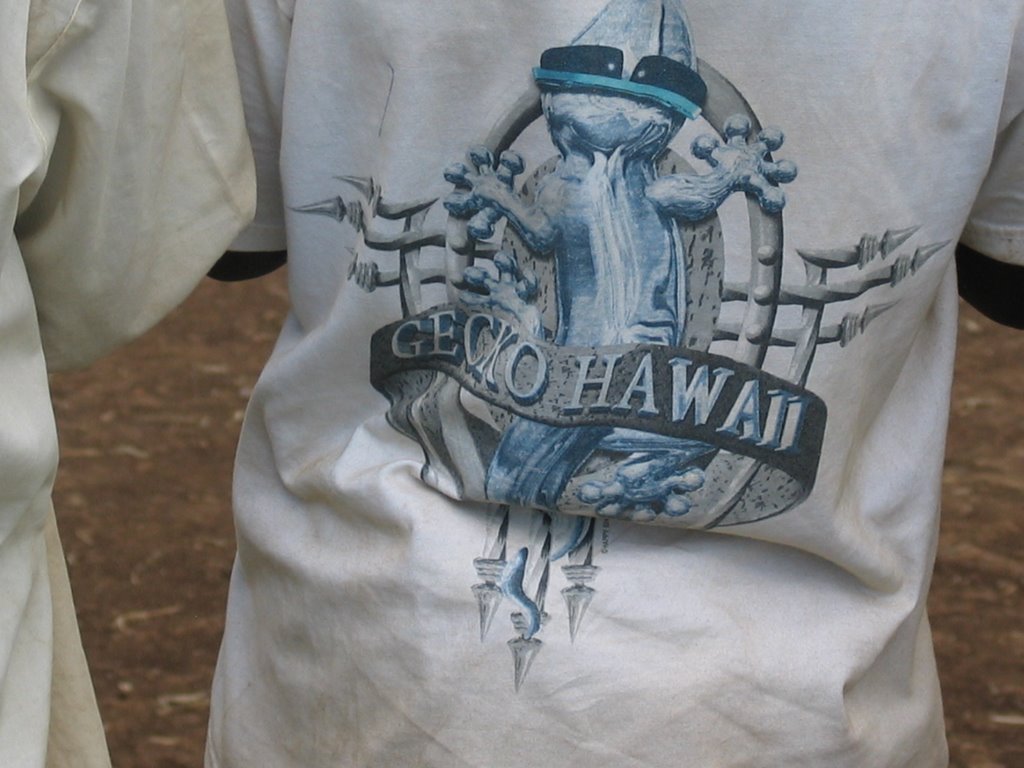
Thinking of Hawaii: spotted this t-shirt on one of the children this week. Probably donated to a Goodwill store by someone in Hawaii, and then sent over to East Africa, where the second hand clothes are sold (not given away!) in the markets. The large amount of second hand clothing that floods the market in East Africa has undermined local clothing manufacturers.

Sunday, May 28, 2006

Links

I'm having difficulty figuring out how to make the links on this page work. Until I do, I'd like to recommend the web sites of my friends, Katy and Bryan: katyincongo.blogspot.com and bgindrc.blogspot.com. I'd also like to recommend the "Women in Congo" photo gallery of the Malteser International organization, which is a branch of the Order of the Knights of St John of Malta - in existence since around 1050AD.
http://www.malteser.de/61.Malteser_International/en/default_en.htm

Saturday, May 27, 2006


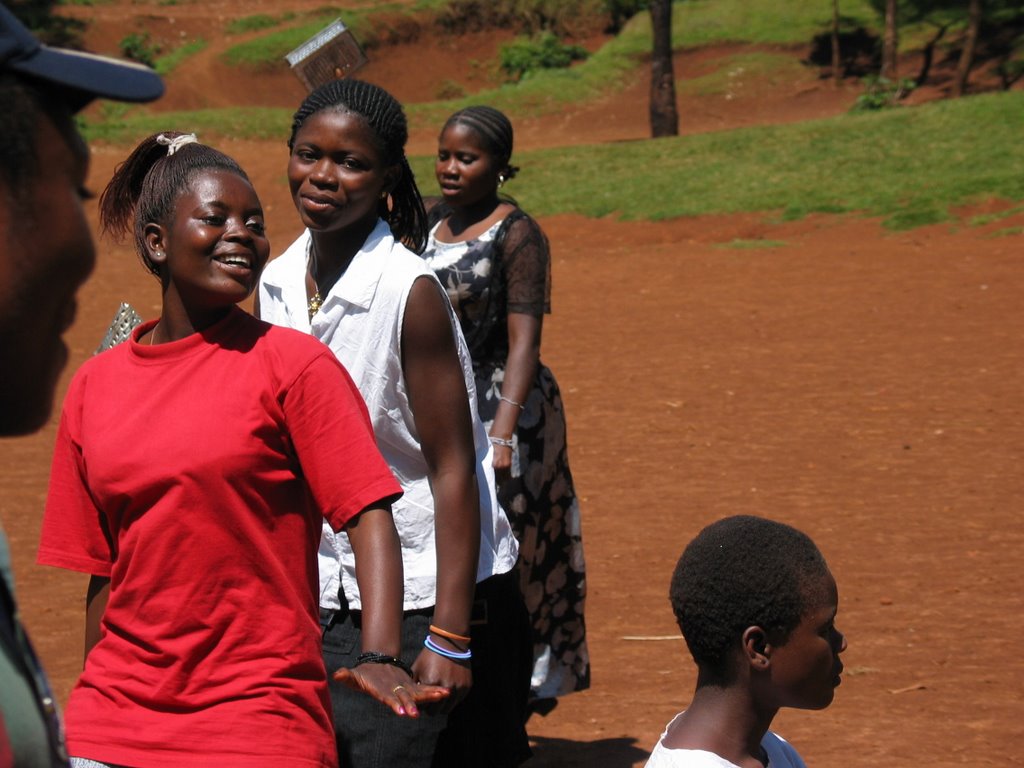
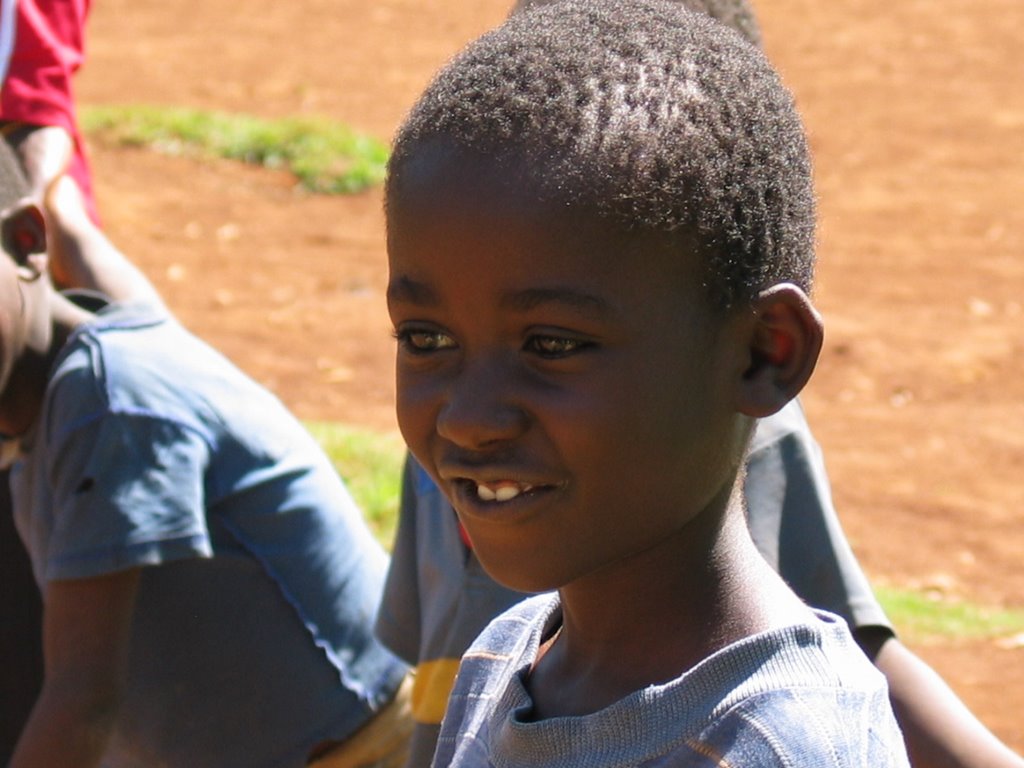
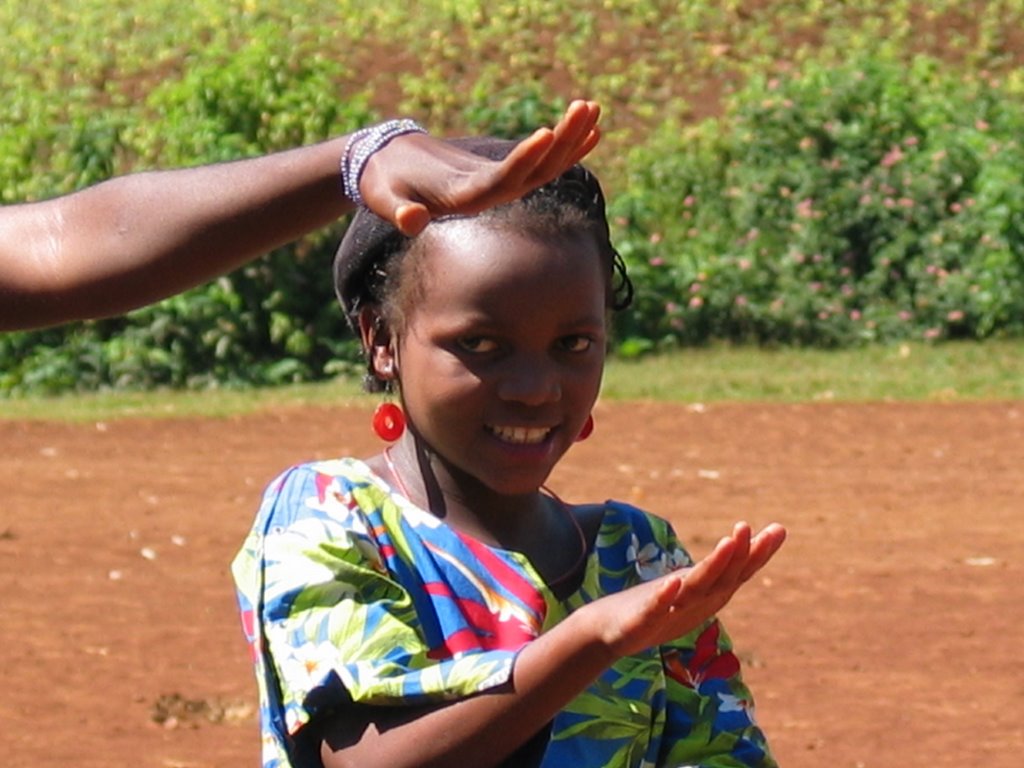
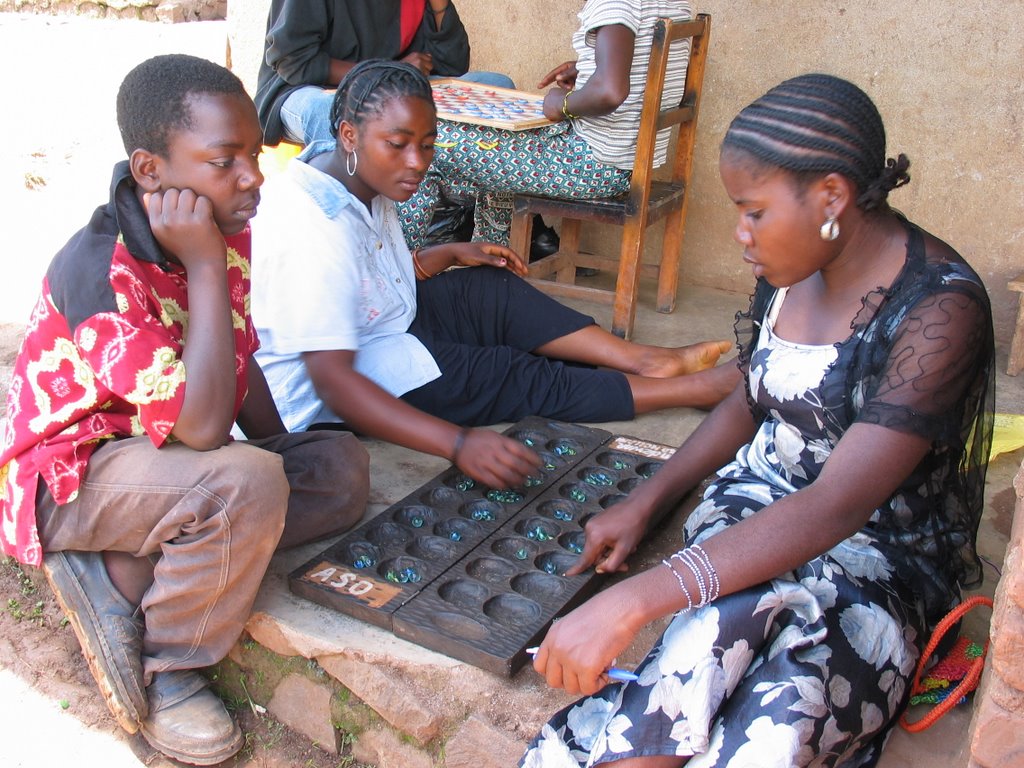
The photos above are of some young people who come to one of the centers where we provide training to the staff. They have all been victimized first by poverty and then by the war. They have very little education and speak almost no French, so it's difficult for me to communicate with them. I haven't yet (in spite of my over-ambitious good intentions) learnt any Swahili. At first they didn't want to be photographed, but after one young woman asked me to take her photo, the others were keen for their pictures to be taken too. The center provides them with skills in trades such as soap-making, tailoring, and wood work. The majority of people here in town are unemployed, so learning skills is essential in order to have a chance of making a living in the future.

Two support staff from a local NGO participate in a creative arts training session. We provide paints, brushes, and training to local associations who work with orphans and marginalised children. Creative activities help the children to express themselves and gain confidence.

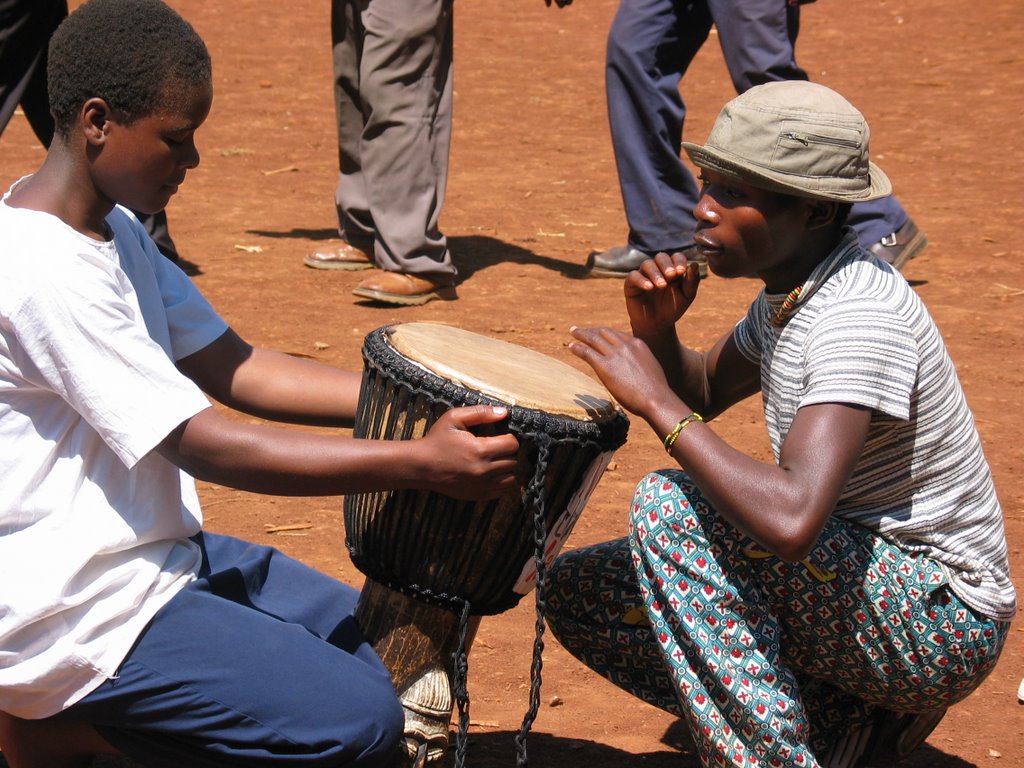
Music is a powerful tool in psychosocial support for young people. It helps them to feel good about themselves and each other. The young women here are dancing to the beat of a drum and music from shakers, or rattles, made locally from tin and filled with dried beans.

Young people on a hillside on the edge of town.

Tuesday, May 23, 2006

Shukuru

Today I visited a small private primary school in a relatively pleasant neighbourhood on the outskirts of town. The school building is a partially completed house that is provided to the community by the owner (I'm not sure if rent is paid, but likely it is). The walls are bare bricks, the floor is packed dirt which probably turns to mud in the rain. The windows have wooden slats nailed across them, with barely any light coming through. Small classrooms are separated from each other with plastic sheeting. There is no electricity, no running water, and the latrines are indescribable, and certainly not suitable for girls reaching the age where they need a bit more privacy. Many young girls in Africa drop out of school simply because there are no suitable toilets for them to use.

The young head teacher told me that they began the school year with 300 pupils, but were now down to 250; the others had been sent away for non-payment of fees. Pupils pay $2.50 a month. That is an enormous sum for a parent who has several children and may only earn a dollar a day. Those who do earn a dollar a day are actually pretty lucky - the vast majority are unemployed and earn nothing. They barely scrape by, and many children die before the age of five. School fees go towards paying the teachers, paying various taxes, and mandatory insurance. And you can be certain that it's all a scam - they receive nothing in return for the taxes, and no insurance monies are ever paid out. It's a parody of what an education system should be: where the state should be paying teachers' salaries and building schools, not stealing from them.

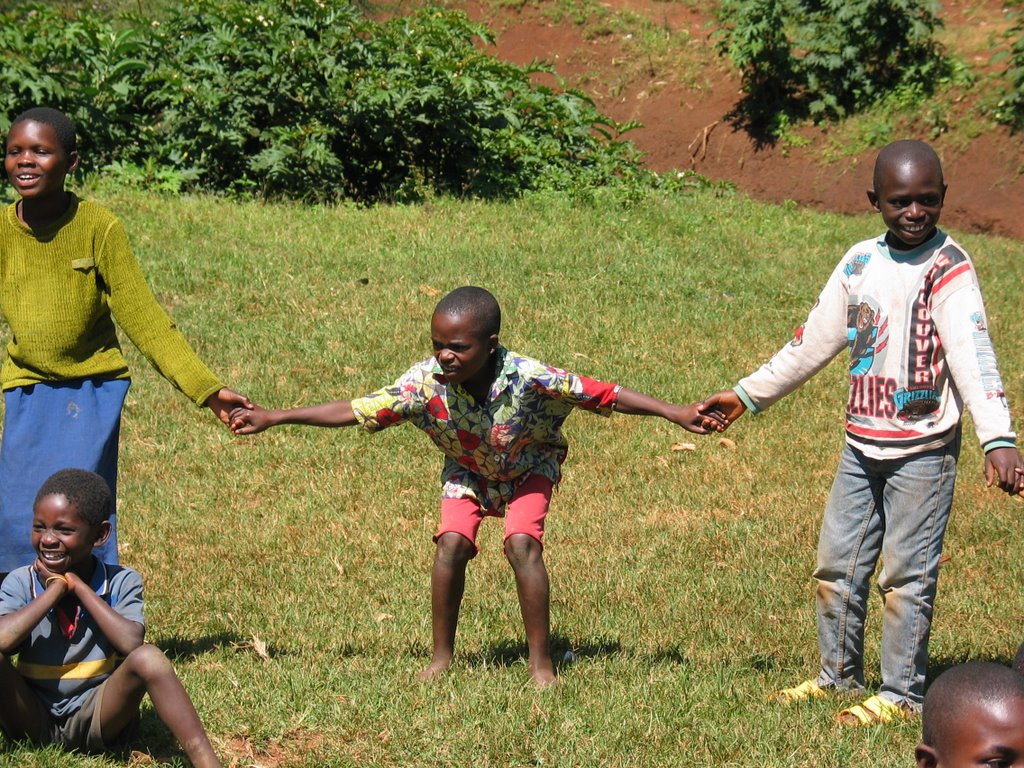
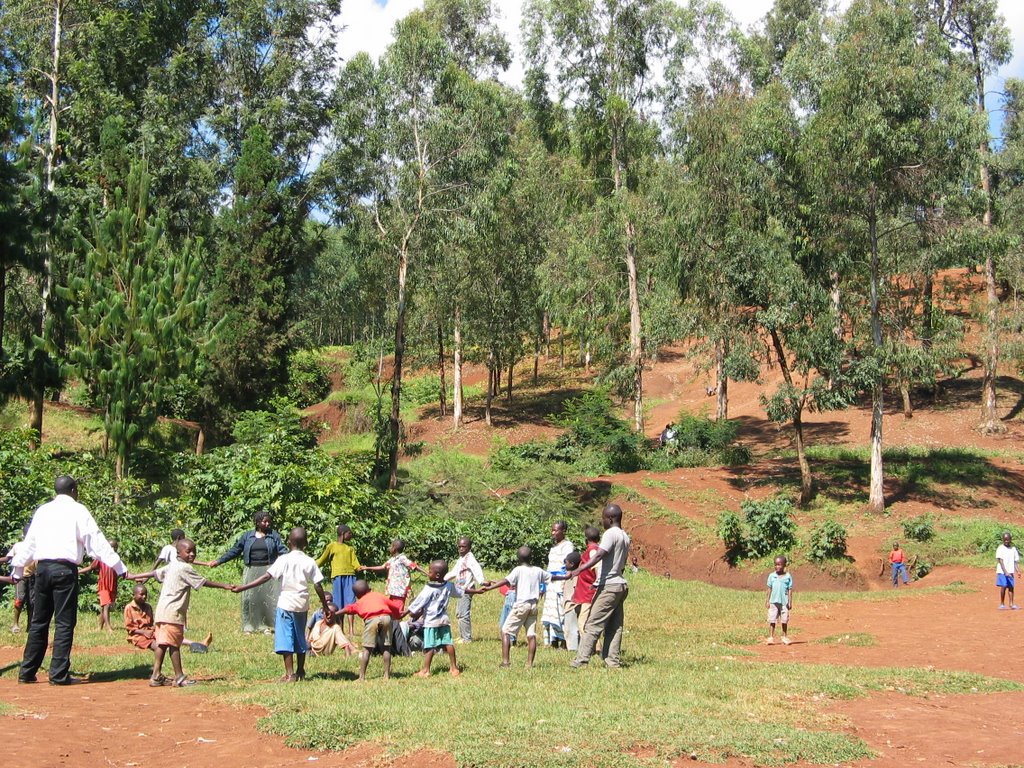
Our session at the school began outside in the sun, with our trainers coaching the teachers in four large circles of young pupils playing games that are designed to improve their concentration, coordination skills, and mutual acceptance of each other. While I watched, a few neighbourhood kids, no more than 3 or 4 years old, sidled up to me. After a while, one slid his tiny hand into mine. I wondered how much affection some of these children get at home, where there are usually too many children, and parents too hassled with the struggle just to feed them to give them individual attention. Is that just a western concept? Don't all children need attention and affection? And while I was watching and thinking about these things, a young boy was suddenly in front of me. "I've been chased out", he told me, looking like his world was coming to an end. He's 11 years old, with worn clothing and inappropriate badly fitting boots, but clean and bright looking. His name is Shukuru; he wants to study. And today his dream just came to an end because his father doesn't have work and there's just no way he can pay his school fees.

Sunday, May 21, 2006

Contrasts

Last night I sat down and uploaded several photos and wrote some text, and then when I hit the "publish" button it all disappeared into that black internet hole. A bit frustrating! There are so many photos already that I'd like to post.

I spent yesterday afternoon drinking tea, reading a book, and chatting with other expat workers on the terrace of a lovely small hotel/restaurant located 20 minutes walk from our office. The terrace has a spectacular view over the lake, nearby islands and the hotel's garden which is a cascade of bamboo, lime trees, torch ginger, bougainvillea, and many other tropcial flowers sloping down to the lake shore. It is beautiful, serene, peaceful; the lake tranquil. The calm belies the terror hidden in the surrounding countryside, where ordinary people and their children are suffering violence and dying at an astounding rate, all but ignored by the international community.

I work with a team of eight local staff. They go out every day and train primary school teachers and staff at orphanages and transition centres for marginalised children. Young women and children are the sorriest victims in this unseen and incomprehenisble war - a mishmash of soldiers, military groups, rebels, armed gangs, all fighting over land, minerals, resources, power. The children have been orphaned by the fighting, some seeing parents murdered before their eyes; they are orphaned by HIV/AIDS; they are dragged into the conflict as child soldiers (both girls and boys) or join willingly on the promise of food; they are raped and then shunned by society; they are accused of witch craft and expelled from families that cannot feed them. But they are still children and young people with the same rights, feelings, and hopes for the future as young people everywhere.